The fastest way to lose a B2B buyer is to ship them one bad container. In our thirteen years of exporting agro commodities, the single most consistent predictor of long-term buyer retention has been one thing: the rigour of our quality control protocol. Below is a walk-through of the 14 steps we run between a farmer's field and our buyer's warehouse — and the specific parameters that get measured at each stage.
Stage 1 — Field-level quality control
Quality cannot be inspected into a product at the end. It has to be grown in. Our procurement team begins QC at the standing crop stage, three to four weeks before harvest. We sample for variety verification, agronomic practices, and irrigation residue. Co-operatives that consistently fail this stage get coached out of our supply chain — politely, but firmly.
- Variety verification — confirming a 1121 basmati farmer is actually growing 1121, not a look-alike.
- Crop calendar audit — ensuring sowing, irrigation, and pesticide events were logged.
- Field moisture readings — to plan harvest timing and post-harvest drying.
- Visual disease and pest survey — flagging issues that will show up in the lab later.
Stage 2 — Post-harvest QC
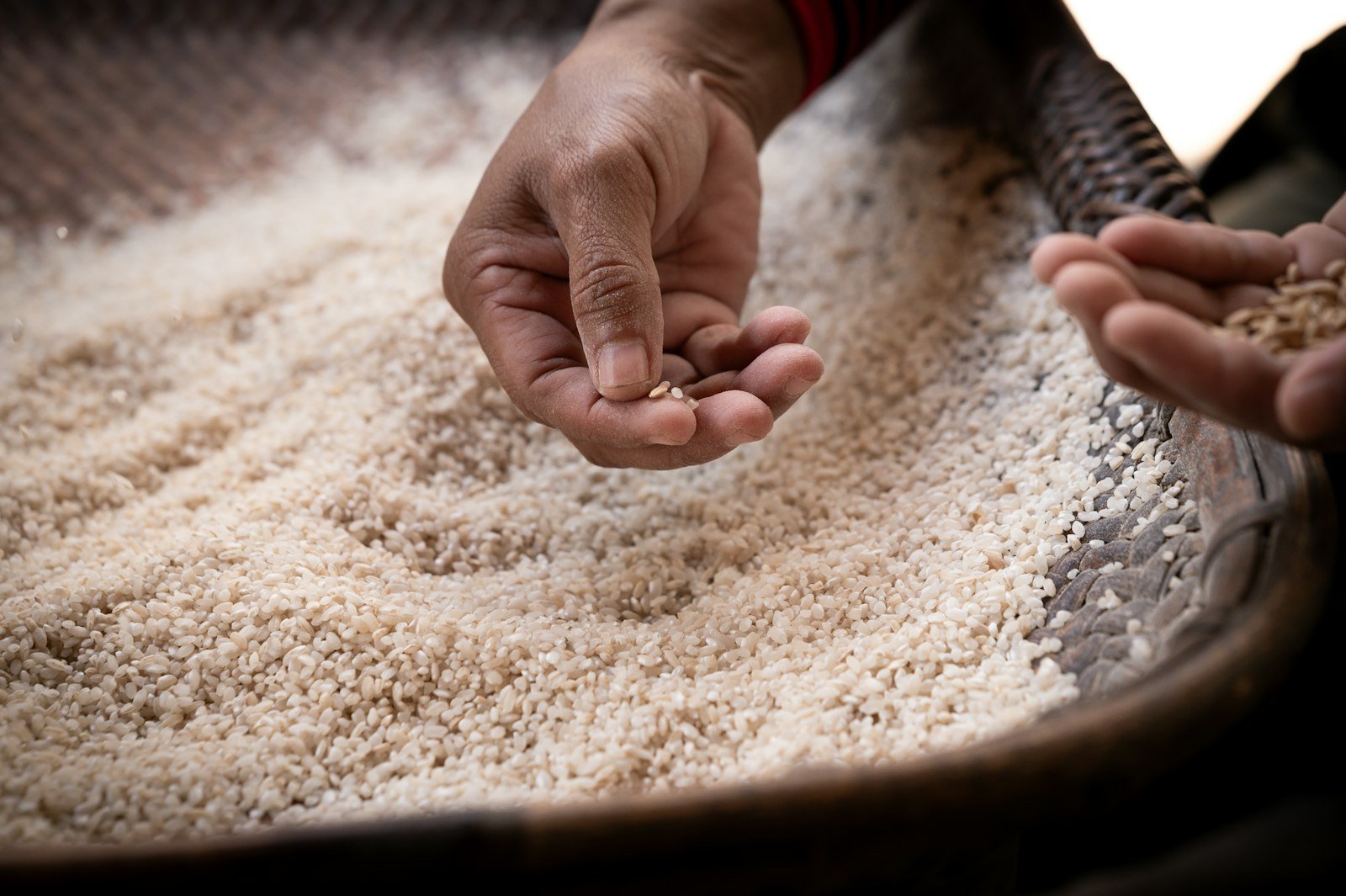
After harvest, the consignment enters our processing facility and is sampled lot-by-lot. Each lot is given a unique code that follows it through processing, packaging, and ultimately appears on the buyer's certificate of analysis (COA). For rice, this is where we measure broken grains, chalkiness, and average grain length. For sesame, we check seed colour uniformity, oil content, and free fatty acid (FFA). For spices, we test for whole-vs-broken ratio, essential oil content, and colour scoring (ASTA for chillies, curcumin percentage for turmeric).
Stage 3 — Lab testing at NABL-accredited partners
Every consignment that will ship goes to a NABL-accredited third-party lab for the parameters our buyer or destination market requires. This is not optional. EU-bound shipments are tested against EU MRLs. Saudi-bound shipments are tested against SASO. Generic shipments are tested against our internal standards, which are conservative enough to clear most regulatory regimes. The reports come back with raw data, and a senior QC manager signs off before the consignment moves to packaging.
Stage 4 — Cleaning and sorting
Modern optical sorters can scan thousands of grains per minute and reject anything that does not match the buyer's spec sheet — by colour, shape, or density. Gravity separators remove stones and heavier impurities. For premium sesame and rice, we run product through two passes of sorting at minimum. The yield loss is real (5-12% depending on lot), but it is the difference between a buyer signing a renewal contract or sending the consignment back.
Stage 5 — Packaging integrity
Packaging is QC, not logistics. A 50 kg PP woven bag that is over-filled by 2% will burst during fumigation. A vacuum pack with a 0.3 mm seam weakness will spoil on the water. We weigh every nth bag, pressure-test every nth vacuum pack, and inspect every pallet stretch-wrap before the consignment is sealed in the container.
- Bag weight check — every 10th unit, ±0.5% tolerance.
- Seam strength — random sampling on vacuum and PE packs.
- Label legibility — lot code, country of origin, packed date, expiry, batch.
- Pallet integrity — bonded stretch-wrap, corner protectors, slip-sheet alignment.
Stage 6 — Container loading and stuffing reports
The final QC stage happens at the container. Our supervisor photographs the empty container interior (looking for residue, moisture, or pest evidence from previous cargoes), supervises loading, and submits a stuffing report with photographs every 10 minutes. This report is shared with the buyer the same day. It has, on more than one occasion, saved a buyer from arguing with their insurer over damage that happened in transit, not at origin.
The most common buyer-side rejections — and how to avoid them
Across thirteen years and roughly 18,000 shipments, three rejection reasons dominate: moisture creep during transit (especially for low-shelf-life products into humid ports), pesticide residue above destination MRLs, and lot-to-lot variability across multi-container orders. All three are entirely preventable upstream — but only if the QC protocol starts at the farm, not at the port.
Talk to our team
Sourcing what you just read about?
Our export desk replies within 24 hours with specs, MOQs, and pricing — usually faster.